ShenZhen Toupwell Technology Co.,Ltd

 | LisaKong |
 | 18925229935 |
 | 0086-755-85218623 |
 | sales@toupwell.com |
 | 2/F.Building A.No.78 of AnLiang Road.YuanShan Street.LongGang District.ShenZhen.GuangDong.China |
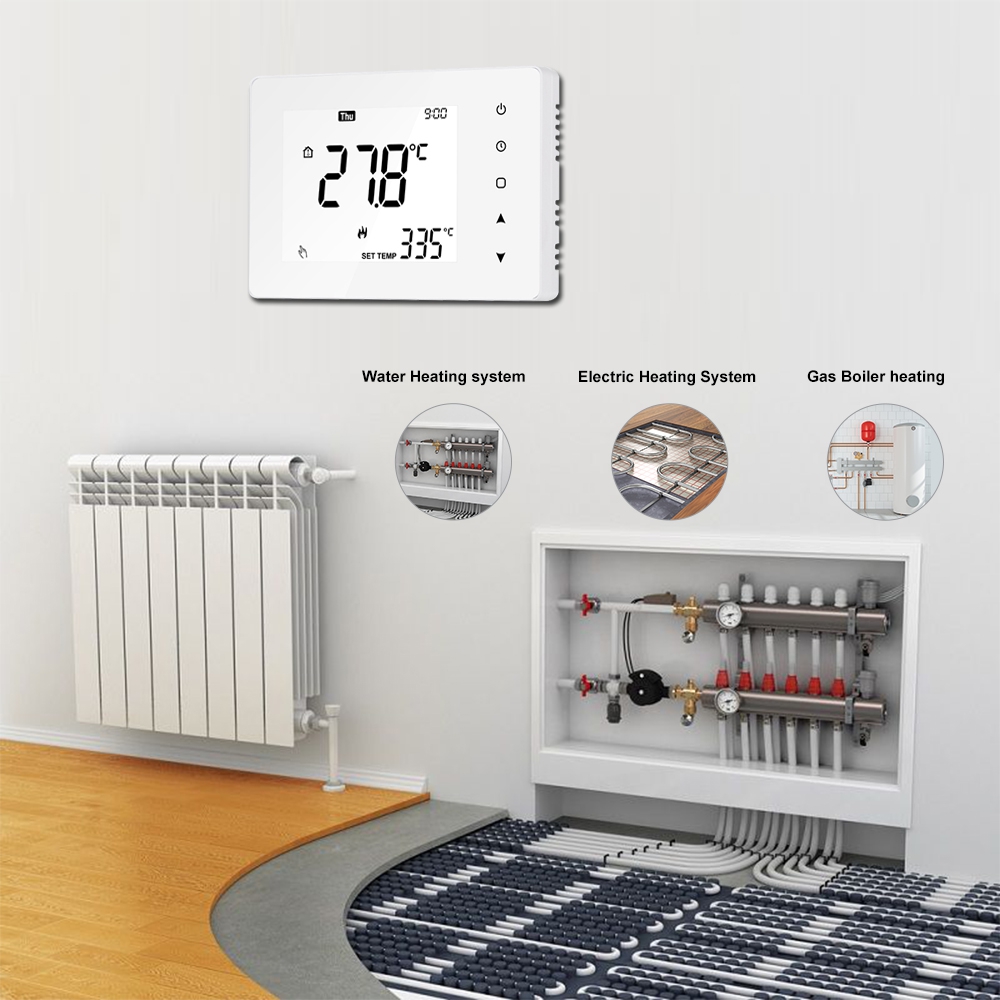
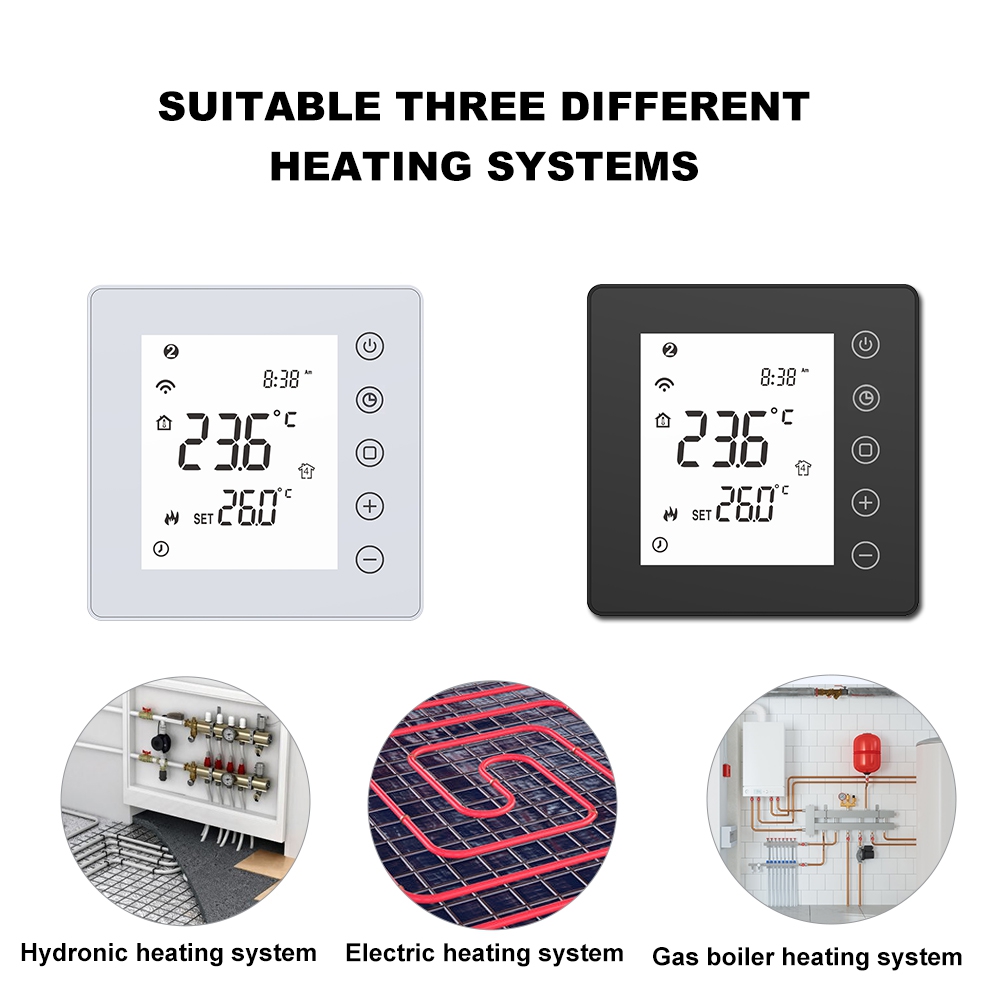
Toupwell manufactures electric underfloor heating thermostats for residential, commercial and smart-building heating-control projects.
Our thermostats are designed to control compatible electric floor heating cables, heating mats and other resistive heating loads. Available options include standard programmable thermostats, WiFi thermostats, Zigbee thermostats and Modbus thermostats.
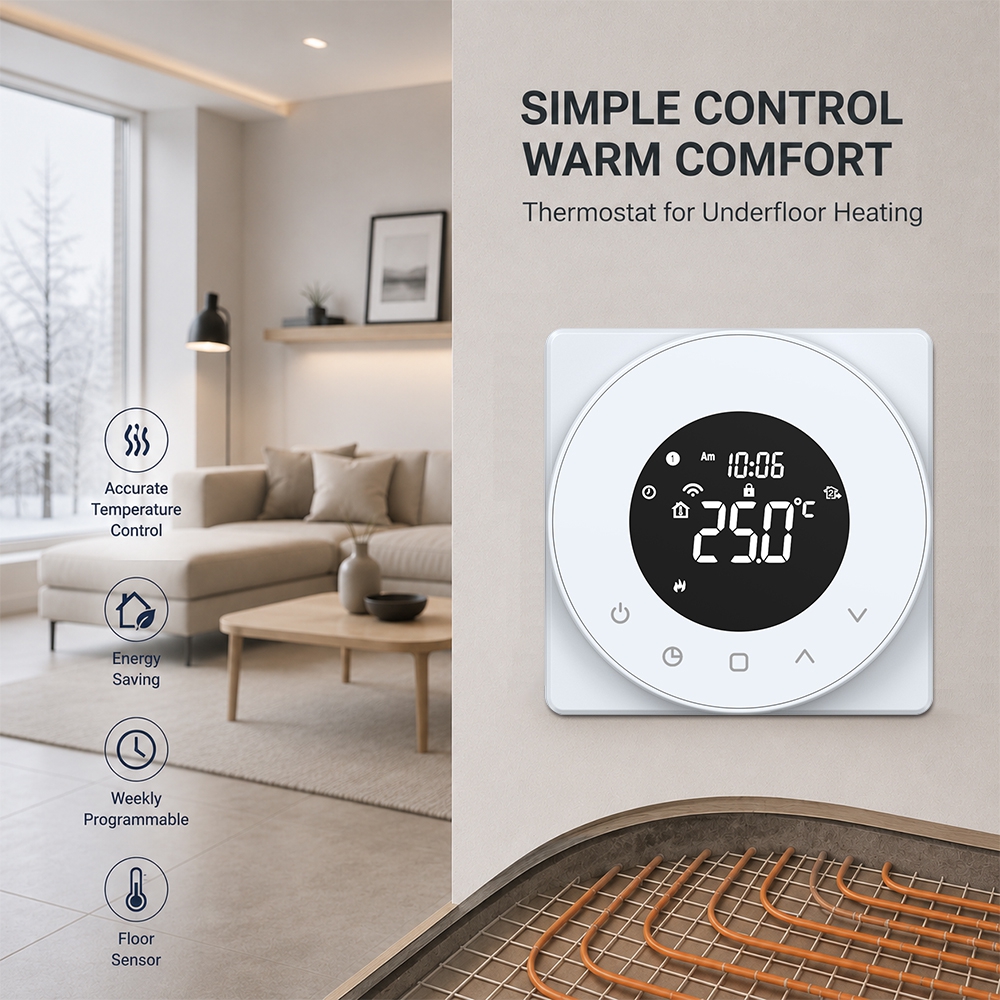
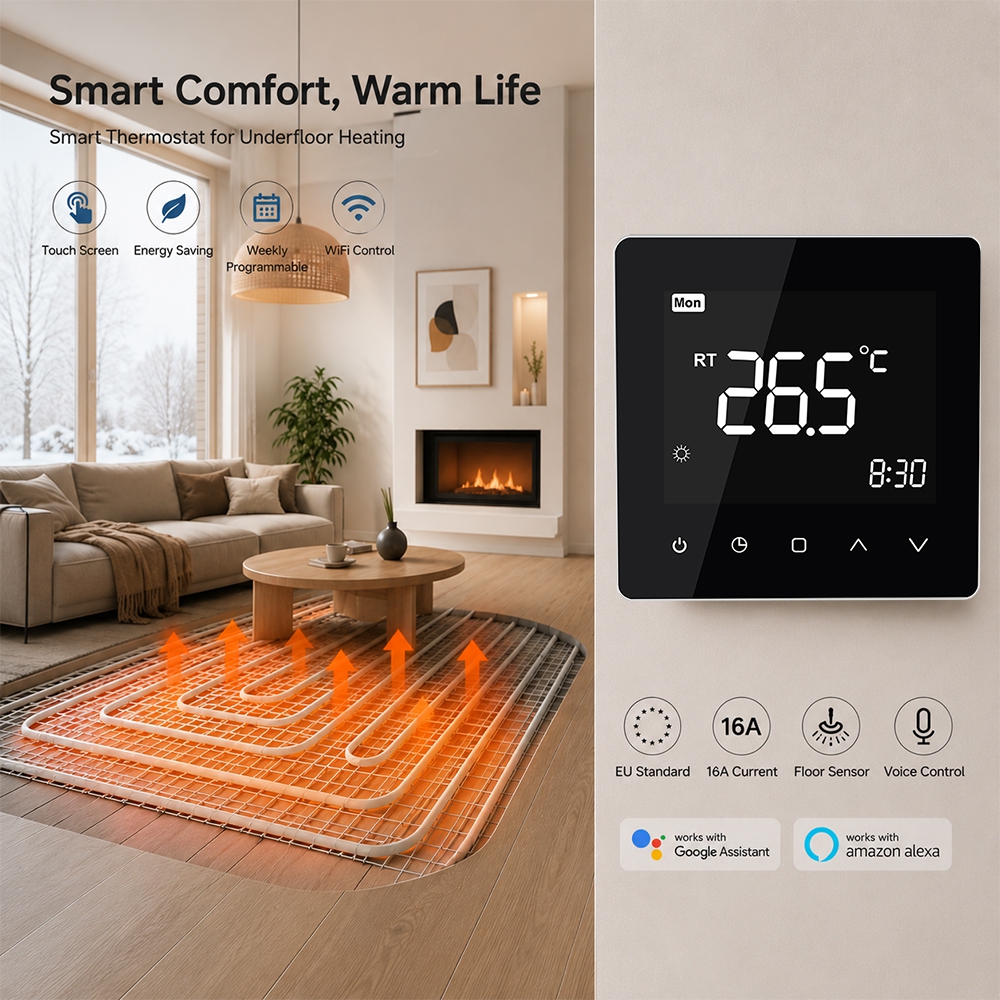
Depending on the selected model, Toupwell electric floor heating thermostats can provide a 16A relay output, built-in room-temperature sensing, an external floor sensor, weekly scheduling, floor-temperature limitation, child lock, frost protection, open-window detection and power-off memory.
OEM and ODM services are available for HVAC distributors, electric floor heating brands, smart-home companies, importers and heating-system suppliers.
Available solutions include:
Standard electric heating thermostats
Programmable floor heating thermostats
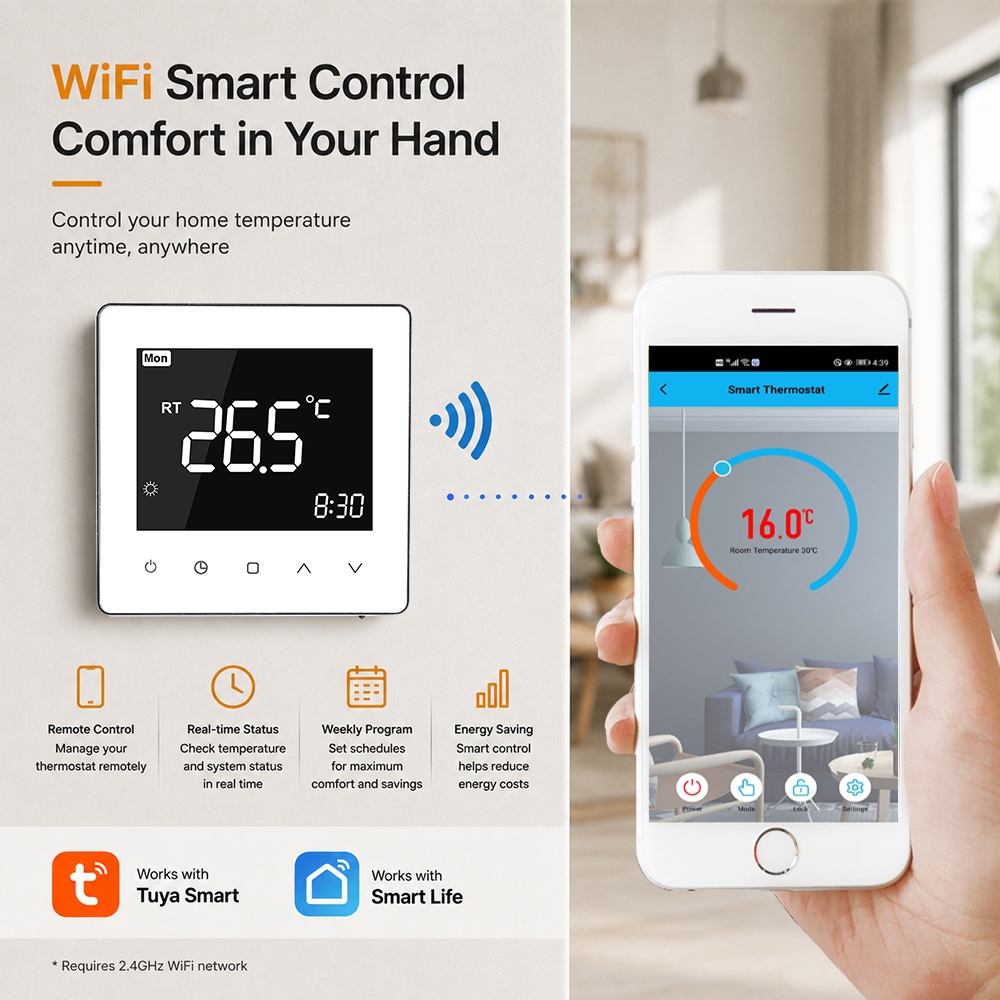
WiFi underfloor heating thermostats
Zigbee electric heating thermostats
Modbus floor heating thermostats
Room and floor dual-sensor control
16A relay output options
95–240V AC and selected 24V configurations
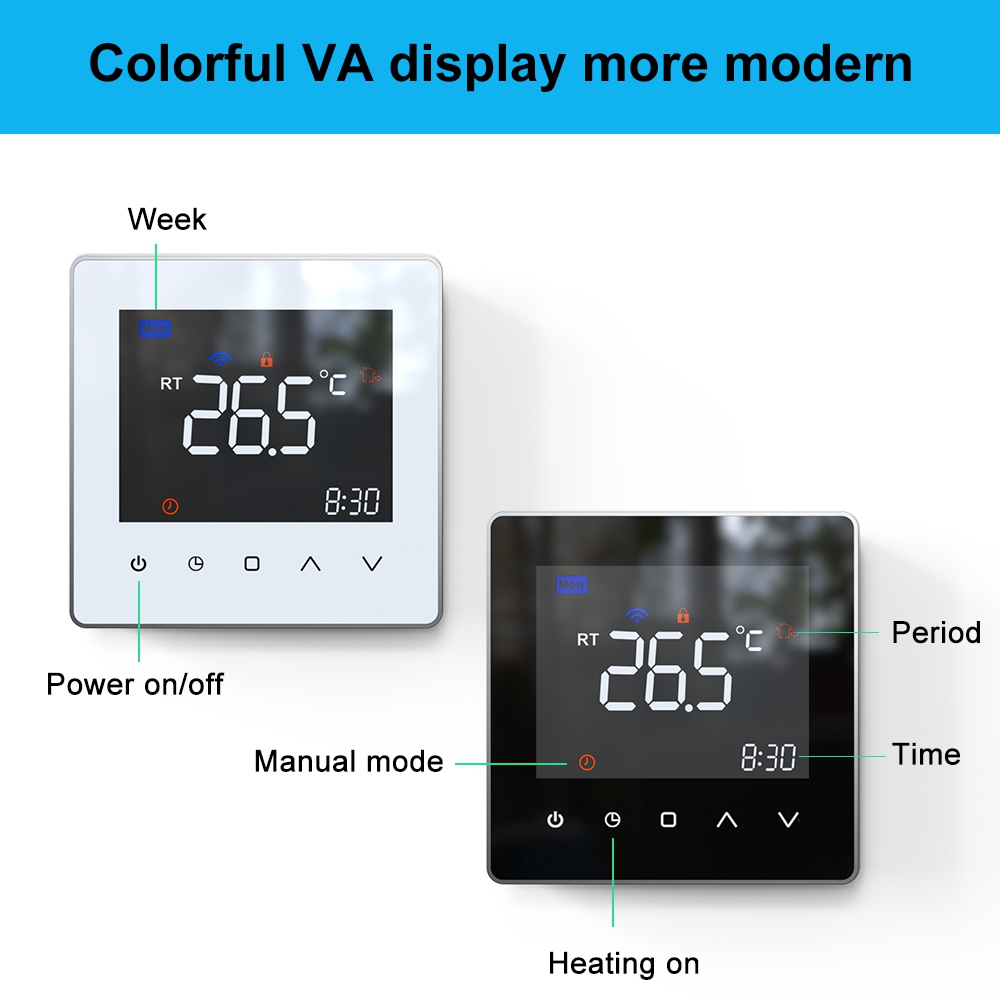
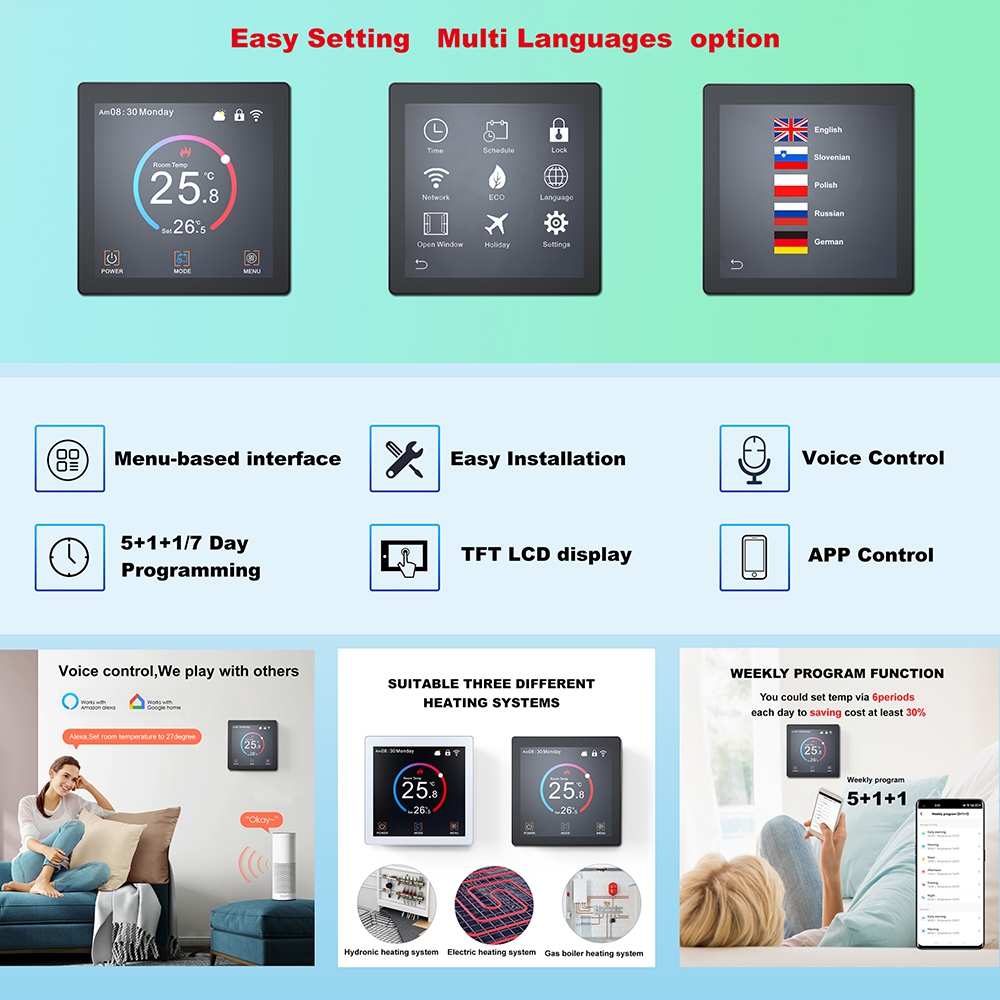
Touchscreen, LCD and LED display options
Tuya and Smart Life app control
Alexa and Google Home-compatible models
OEM logo, housing, packaging and firmware customization
An electric underfloor heating thermostat measures the room temperature, floor temperature or both and switches the heating load according to the selected setpoint and control mode.
A typical operating sequence is:
The room or floor sensor measures the current temperature.
The thermostat compares it with the selected setpoint.
The internal relay switches the heating cable or mat on when heat is required.
The floor temperature rises and transfers heat into the room.
The thermostat switches the load off when the target or floor limit is reached.
The cycle repeats to maintain the required comfort level.
The thermostat must be matched to the heating-system voltage, total electrical load, floor sensor and installation requirements.
Sensor configuration is one of the most important differences between an ordinary room thermostat and a thermostat designed for electric floor heating.
The internal air sensor measures the temperature around the thermostat.
Room-sensor control is useful when the objective is to maintain a stable indoor air temperature.
Its accuracy can be affected by installation conditions such as:
Direct sunlight
Exterior walls
Drafts
Nearby doors
Heated pipes
Electrical equipment
Poor air circulation
Installation too close to the floor
The thermostat should be installed in a representative location for the room.
The external floor probe measures the temperature inside or beneath the floor construction.
It can be used to:
Control the floor according to a target temperature
Prevent excessive floor temperature
Protect temperature-sensitive floor finishes
Provide stable floor comfort
Support bathroom and tiled-floor heating
The probe should normally be installed in a conduit so that replacement is possible without opening the finished floor.
A dual-sensor thermostat uses both the internal room sensor and the external floor sensor.
In a typical combined mode:
The room sensor controls indoor comfort.
The floor sensor acts as a maximum or minimum limit.
Heating stops when the floor limit is reached.
The floor is protected even when the room still requires heat.
The correct floor-temperature limit depends on the floor construction, heating system and flooring manufacturer’s instructions.
Check whether the heating cable or mat uses:
110–120V
220–240V
Another project-specific voltage
The thermostat power supply and output must match the heating system.
A model designed for European 230V electric heating should not automatically be assumed suitable for a North American 120V installation.
Add the rated wattage of every heating mat or cable connected to the thermostat.
The load current can be estimated using:
Current = Total Heating Power ÷ Supply Voltage
For example, a 3,000W heating system operating at 230V draws approximately 13A.
The calculated current must remain below the thermostat’s rated resistive load and any limits required by the installation standard.
When the total heating load exceeds the thermostat rating, use a correctly selected external contactor, relay or power module rather than connecting the load directly.
Determine whether the installation requires:
Room-temperature control
Floor-temperature control
Combined room and floor control
Floor maximum limitation
Floor minimum limitation
Replacement of an existing sensor
For replacement projects, confirm the resistance value of the installed floor sensor. Different thermostat brands may use different NTC sensor values.
Different floor finishes tolerate different operating temperatures.
Common electric floor heating applications include:
Ceramic tile
Porcelain tile
Natural stone
Engineered wood
Laminate
Vinyl
Carpet-compatible systems
The thermostat limit should follow the heating-system and floor-covering manufacturer’s requirements.
Do not use one universal maximum floor temperature for every material.
Select the thermostat according to how the project will be operated.
| Control Requirement | Recommended Thermostat |
| Simple local temperature setting | Standard digital thermostat |
| Automatic daily schedules | Programmable thermostat |
| App-based remote access | WiFi thermostat |
| Multi-device smart-home system | Zigbee thermostat |
| Hotel or BMS integration | Modbus thermostat |
| Premium user interface | TFT touchscreen thermostat |
| Floor protection | Dual-sensor thermostat |
Toupwell models may be designed for compatible European round boxes or 86-type installation boxes.
Before ordering, confirm:
Wall-box type
Screw-hole distance
Wall depth
Cable space
Faceplate dimensions
Local installation practice
This is especially important for replacement projects and private-label products sold in several countries.
Requirements vary by market and application.
Before ordering, provide:
Destination country
Supply voltage
Heating load
Installation location
Required certifications
Ground-fault protection requirement
Packaging and label requirements
Importer or distributor information
For bathroom, wet-area and North American projects, confirm whether the installation requires integrated or external ground-fault protection.
A qualified electrician should determine the appropriate protective devices and wiring method.
Selected Toupwell electric heating thermostats use a 16A relay for direct control of compatible resistive heating loads.
However, buyers should not select a thermostat based only on the “16A” label.
The installation must also consider:
Continuous load
Supply voltage
Cable size
Terminal capacity
Circuit breaker
Local derating requirements
Relay inrush and switching conditions
Ambient temperature
Wall-box ventilation
Number of heating cables
External contactor requirements
When several heating mats serve the same room, calculate their combined load.
A thermostat should not be operated above its rated capacity.
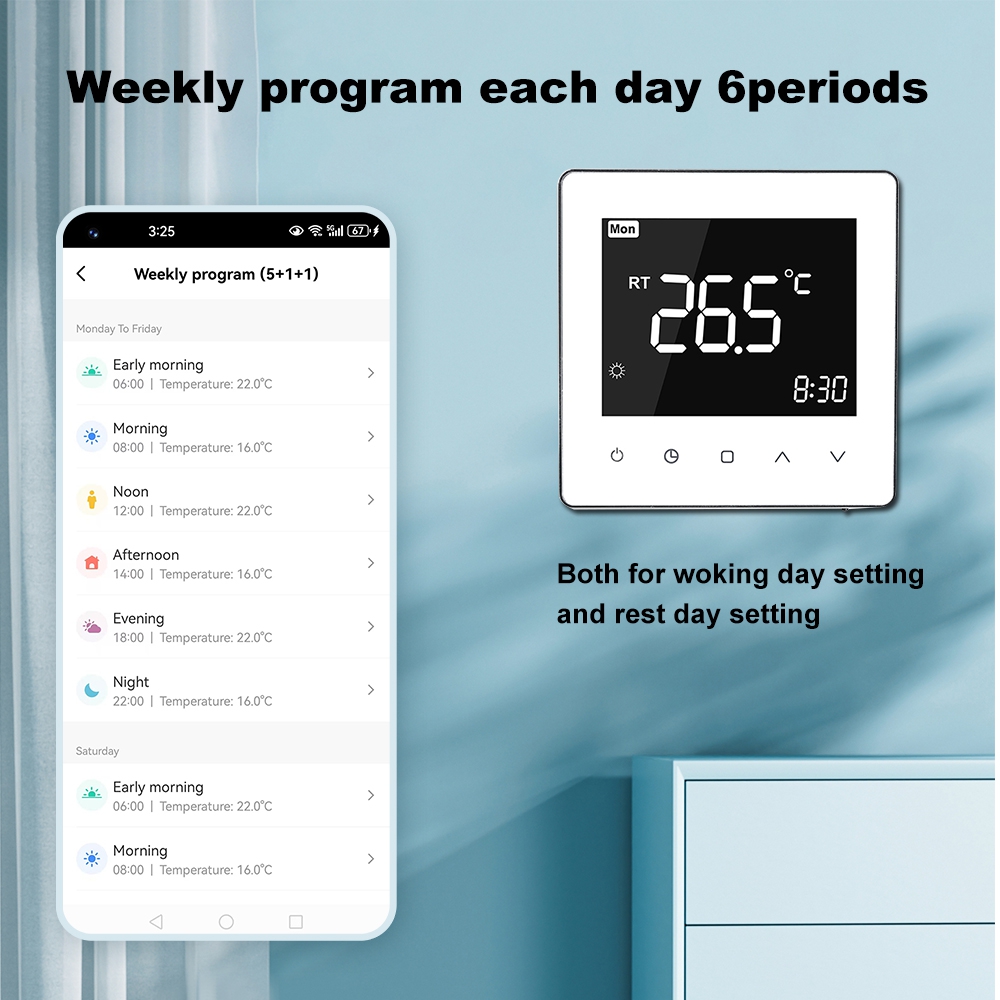
Weekly programming reduces unnecessary operation by using different temperatures for occupied and unoccupied periods.
Selected models support separate weekday, Saturday and Sunday programs with multiple time and temperature periods.
Floor limitation stops heating when the floor sensor reaches the configured maximum.
This function is particularly important for temperature-sensitive floor materials.
Open-window detection responds to a rapid reduction in room temperature and can temporarily reduce or stop heating.
Its performance depends on thermostat location, room conditions and the configured detection parameters.
Child lock prevents accidental changes to temperature, schedule and operating modes.
It is useful in:
Family homes
Hotels
Schools
Rental properties
Public areas
Commercial rooms
Frost protection maintains a low minimum temperature when normal comfort heating is not required.
This can be useful for vacant rooms, holiday properties and seasonal buildings.
Power-off memory retains configured settings after a temporary loss of electricity.
The exact stored information depends on the model and firmware.
Selected LCD, LED and TFT models provide adjustable brightness for bedrooms, hotel rooms and other light-sensitive spaces.
A temporary override allows users to change the temperature during a programmed period without permanently deleting the weekly schedule.
| Thermostat Type | Main Connection | Gateway Required | Best Application | Main Advantage |
| Standard programmable | No network connection | No | Individual rooms and apartments | Simple operation and weekly scheduling |
| WiFi thermostat | 2.4 GHz WiFi | Usually no separate gateway | Homes and rental properties | Remote app control |
| Zigbee thermostat | Zigbee network | Yes | Multi-device smart-home projects | Low-power mesh networking |
| Modbus thermostat | RS-485 wired bus | BMS or master controller | Hotels and commercial buildings | Central monitoring and control |
The communication method should match the complete project architecture rather than being selected only because it is described as “smart.”
Toupwell provides OEM and ODM electric floor heating thermostat services for HVAC distributors, heating brands, importers, wholesalers and smart-home companies.
Available customization may include:
Private-label logo
Custom housing color
Glass-panel design
Display layout
Button icons
User-interface language
Temperature range
Weekly programming
Floor-sensor value
WiFi, Zigbee or Modbus communication
Tuya or Smart Life configuration
Firmware functions
Hardware output
Wall-box compatibility
Packaging
User manual
Product labels
Carton markings
Customization feasibility, MOQ and development time depend on the required changes.
If you have questions or suggestions,please leave us a message,we will reply you as soon as we can!
0086-755-85218623
LisaKong
18925229935
www.toupwell.com
2/F.Building A.No.78 of AnLiang Road.YuanShan Street.LongGang District.ShenZhen.GuangDong.China
Please read on, stay posted, subscribe, and we welcome you to tell us what you think.


CopyRight © 2025 ShenZhen Toupwell Technology Co.,Ltd